
Speech Therapy Billing Changes 2027
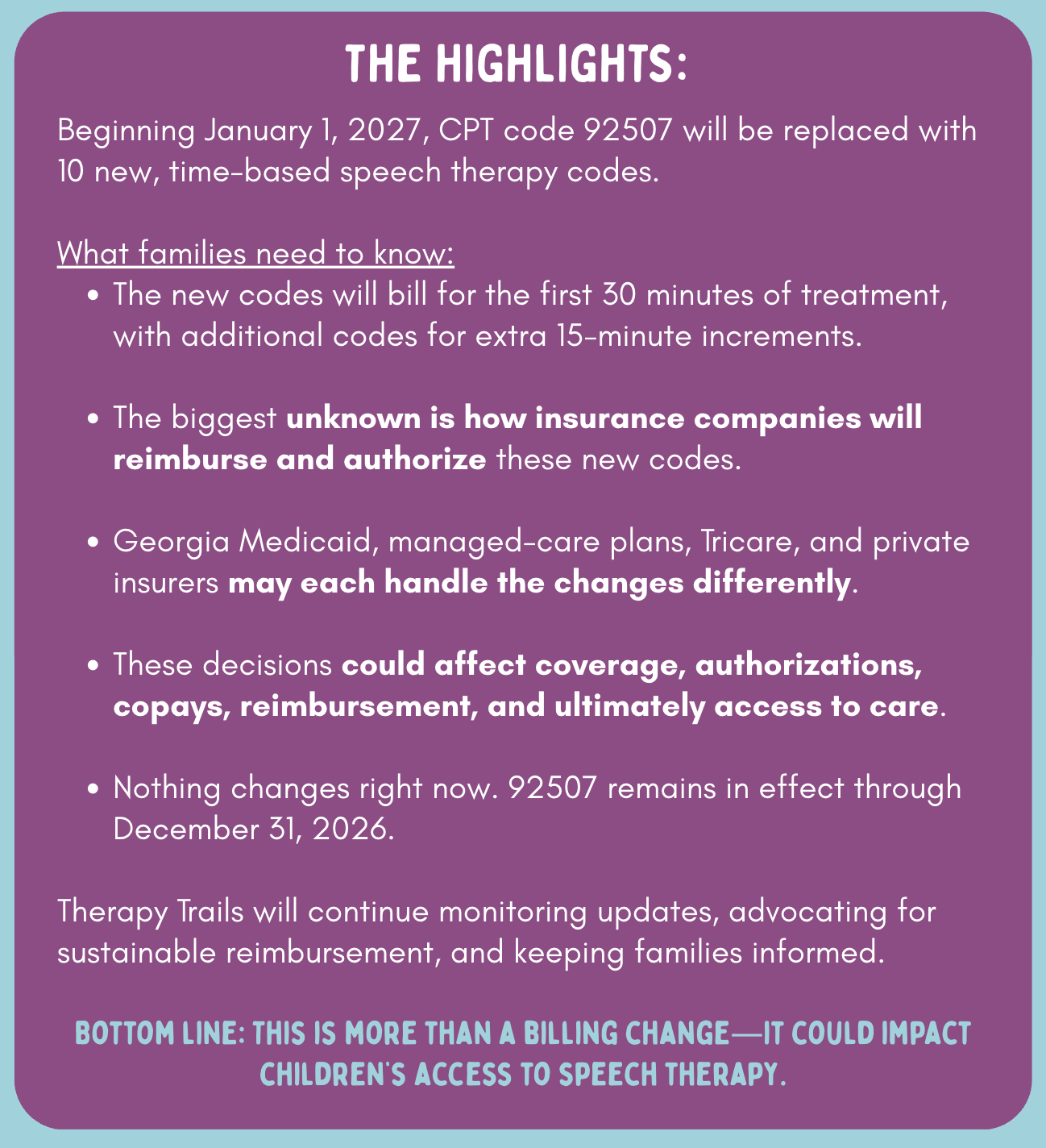
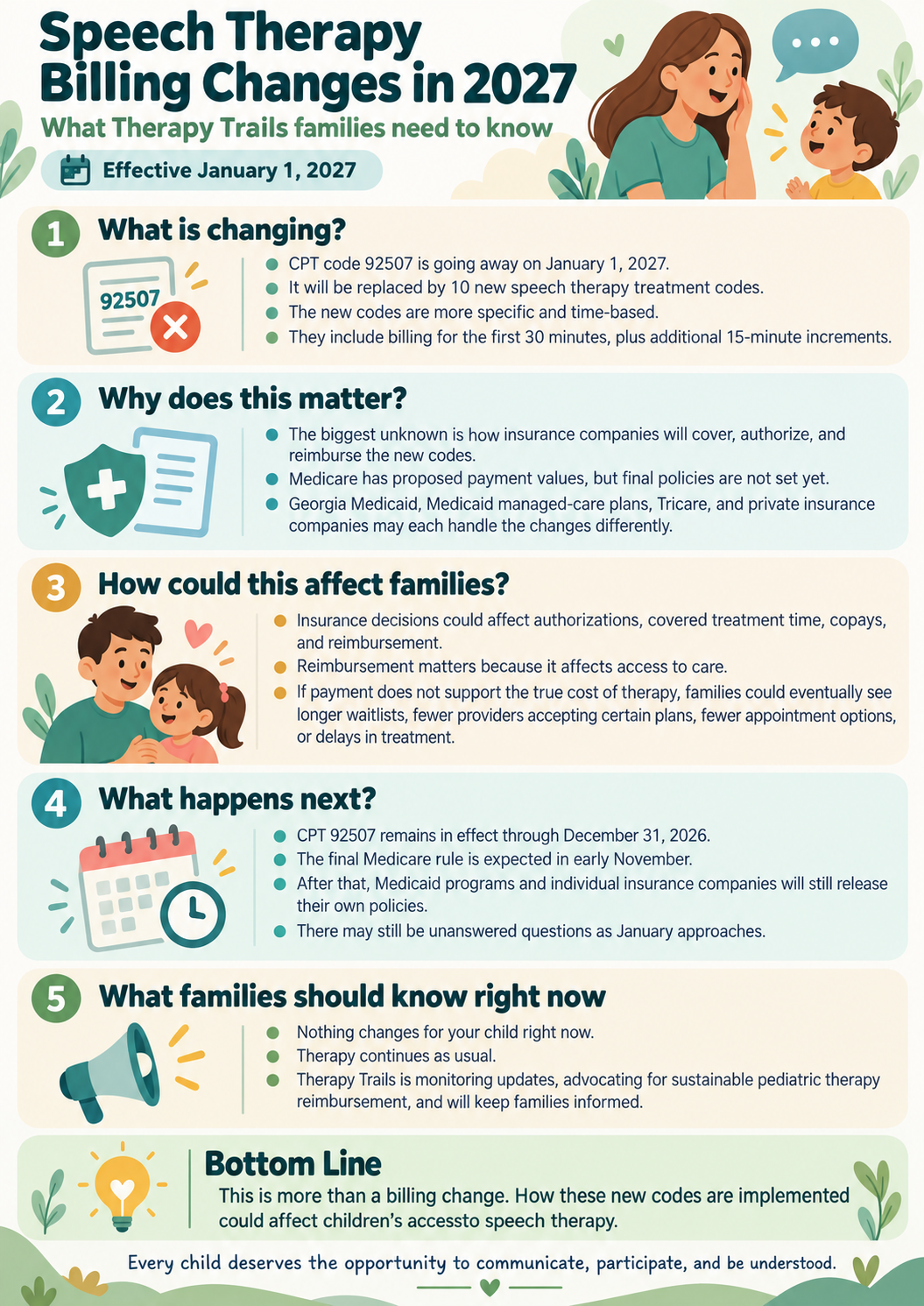
If your child receives speech therapy, you may hear more over the next several months about changes coming to CPT code 92507 beginning January 1, 2027.
Most parents have no reason to know what a CPT code is, how an insurance company determines reimbursement, or how those decisions happen behind the scenes.
And normally, you shouldn't have to.
But this particular change is important because decisions being made now could eventually affect something that matters very much to families:
Will children continue to have access to the speech therapy they need?
First, what is CPT code 92507?
CPT codes are billing codes healthcare providers use to describe the services they provide to insurance companies.
For more than two decades, 92507 has been the primary code used for individual speech and language therapy.
It currently covers many different types of communication treatment, including speech sound disorders, language disorders, fluency, voice, and other communication needs.
It is also currently an untimed code. In other words, the same code is generally used whether an individual treatment session lasts 30, 45, or 60 minutes.
Beginning January 1, 2027, that will change.
CPT code 92507 will be eliminated and replaced with 10 new speech-language pathology treatment codes.
The new codes divide treatment into five clinical areas:
Fluency
Speech sound production
Language comprehension and expression
Combined speech sound production and language
Voice, upper airway dysfunction, and resonance
Each category will include a code for the first 30 minutes of direct treatment and an additional code for each additional 15 minutes.
In many ways, having more specific codes makes sense. Speech-language pathology has evolved tremendously, and the new codes may better describe what SLPs actually do.
The concern isn't simply that the codes are changing.
The bigger question is how insurance companies will value, cover, authorize, and reimburse those services.
Why are speech therapists concerned?
The Centers for Medicare & Medicaid Services (CMS) has proposed payment values for the new codes as part of the 2027 Medicare Physician Fee Schedule.
Those payment policies are not final yet.
CMS has also proposed a separate pediatric speech-language pathology code, called GSLPP. This code was not part of the original CPT development process and has raised additional concerns within the pediatric therapy community.
Under the current proposal, the pediatric code would be based on 60 minutes of personally performed treatment, even though many pediatric outpatient speech therapy sessions—including many at Therapy Trails—are provided in shorter treatment increments.
ASHA has raised concerns that the proposed pediatric code may not accurately reflect the way pediatric speech-language pathology is actually delivered and could create additional administrative and reimbursement challenges.
The final Medicare rule is expected later this year.
"But my child doesn't have Medicare. Why does this matter to us?"
This is an important question.
Most of the children we serve at Therapy Trails do not have Medicare.
And Medicare does not determine exactly what every other insurance company will pay.
Georgia Medicaid, Medicaid managed-care plans, and private insurance companies will establish their own coverage and reimbursement policies. They are not required to simply adopt Medicare's payment rates.
However, the Medicare process is important because these new CPT codes will be introduced across the healthcare system beginning January 1.
That means insurers across the country now have to decide:
Which new codes they will recognize
How much they will reimburse for them
Whether authorization requirements will change
How many units or minutes they will authorize
How existing authorizations will transition to the new codes
Whether additional treatment time will be covered
How copays, coinsurance, and deductibles will apply
Whether their claims-processing systems will be ready January 1
And right now, we do not have all of those answers.
Why does reimbursement matter to families?
It can be easy to think of reimbursement as simply a business issue between a therapy clinic and an insurance company.
But reimbursement ultimately affects access to care.
When an insurance company pays for a therapy session, that reimbursement supports much more than the minutes a therapist spends sitting across the table from a child.
It helps support:
Highly trained speech-language pathologists
Therapist preparation and documentation
Caregiver education
Collaboration with physicians, schools, and other professionals
Continuing education and specialty training
Standardized testing materials
AAC devices and technology
Therapy materials and equipment
Electronic medical records
Billing and authorization teams
Administrative staff
Treatment space, utilities, insurance, and other costs required to operate a healthcare practice
If the cost of providing therapy continues to increase while reimbursement decreases or fails to keep pace, providers eventually have to make difficult decisions.
Across healthcare, unsustainable reimbursement can result in practices limiting participation with certain insurance plans, reducing available appointments, having difficulty recruiting and retaining therapists, or—in some cases—discontinuing services altogether.
And when there are fewer providers available, families feel it.
That can look like:
Longer waitlists.
Fewer therapists accepting insurance.
Longer drives for care.
Fewer appointment choices.
And delays in medically necessary treatment.
That is why this conversation is about much more than changing a billing code.
It is about protecting access to care.
What could this mean for my child's therapy?
For now, the most accurate answer is:
We don't fully know yet.
CPT code 92507 remains in effect through December 31, 2026, and the new codes officially begin January 1, 2027.
Many Therapy Trails speech therapy appointments are already provided in 30-minute increments, so the initial 30-minute structure of the new codes may align well with many of our current services.
But appointment length isn't our biggest concern.
The bigger question is how each insurance company chooses to implement and reimburse the new codes.
Different insurers could make very different decisions.
As we receive information from Georgia Medicaid, Medicaid managed-care organizations, Tricare, and commercial insurance companies, we will evaluate how those decisions may affect our patients and communicate important changes to families.
Where does advocacy stand now?
There has already been significant advocacy surrounding these changes.
ASHA has provided feedback to CMS regarding the proposed 2027 Medicare payment policies and has specifically raised concerns about the proposed pediatric GSLPP code. Among other issues, ASHA has asked CMS to reconsider that pediatric code and has advocated for policies that more accurately represent speech-language pathology services.
The formal public comment period for the proposed Medicare rule has now closed.
The next major step is the release of the final 2027 Medicare Physician Fee Schedule, which is expected in early November.
But even after Medicare publishes its final rule, the work will not be finished.
State Medicaid programs and individual insurance companies will still need to determine how they will handle the new CPT codes.
That means there may continue to be unanswered questions—and potentially different answers from different insurance plans—as January approaches.
No matter what the code says...
A billing code cannot measure the moment a child communicates a new word.
It cannot measure the relief a parent feels when their child can finally tell them what they need.
It cannot measure confidence, connection, independence, or participation.
And it certainly cannot determine the value of a child's ability to communicate.
At Therapy Trails, we will continue advocating for sustainable access to pediatric therapy while adapting to the changes ahead.
Every child deserves the opportunity to communicate, participate, and be understood.
And no matter what number appears on the insurance claim in 2027, that will continue to be the heart of what we do.